Best CRM Software in Kenya: What to Actually Look For Before You Buy
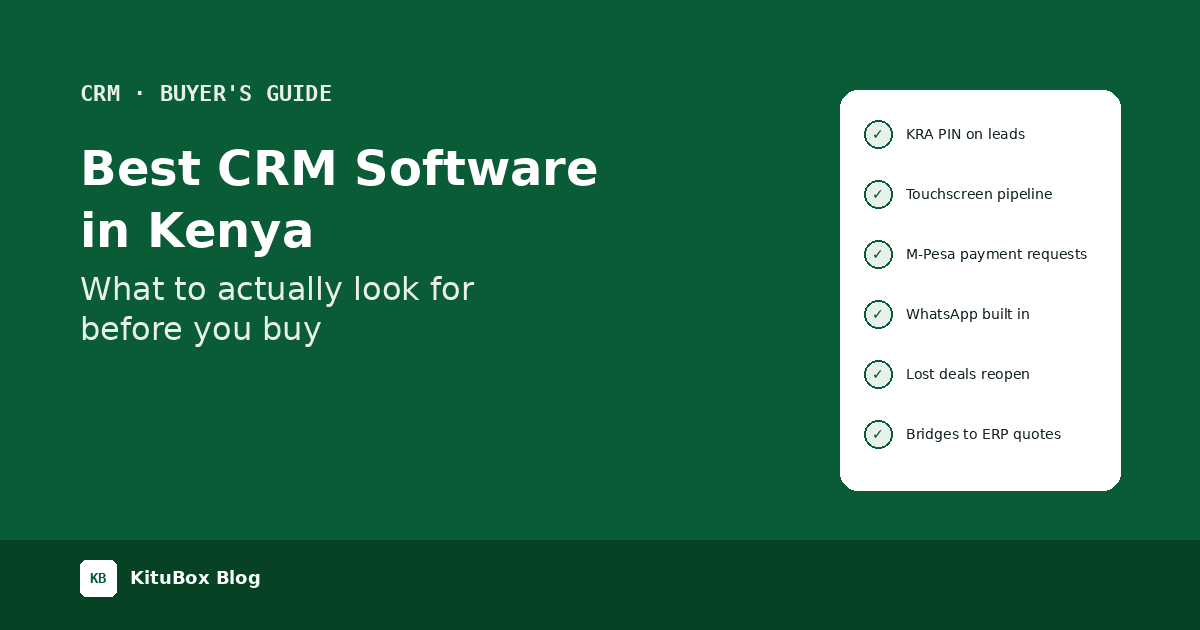
Search "CRM" and you'll find hundreds of products that all look roughly the same in a screenshot: a pipeline board, some contact cards, a reports tab. What actually separates them, especially for a Kenyan SME sales team, shows up in details that don't make it into a feature comparison table. This is a checklist built around those details.
1. Lead records should fit how business actually gets done here
A lead record copied from a template built for a different market usually has fields for company name, address, and maybe a generic "notes" box. That's not enough context for how Kenyan B2B sales actually work, where a KRA PIN matters for a corporate account, and county or town tells you more about territory and follow-up logistics than a street address ever will.
Look for a lead record that distinguishes individual from corporate leads, captures KRA PIN where relevant, and treats county and town as real fields, not something you'd have to cram into a notes field.
2. The pipeline needs to work on a touchscreen, not just a mouse
A lot of CRM pipeline boards are designed assuming a desk, a mouse, and someone dragging cards between columns. That's a reasonable assumption in an office. It's a much worse one for a sales rep standing in a shop or a field visit, working from a phone or tablet.
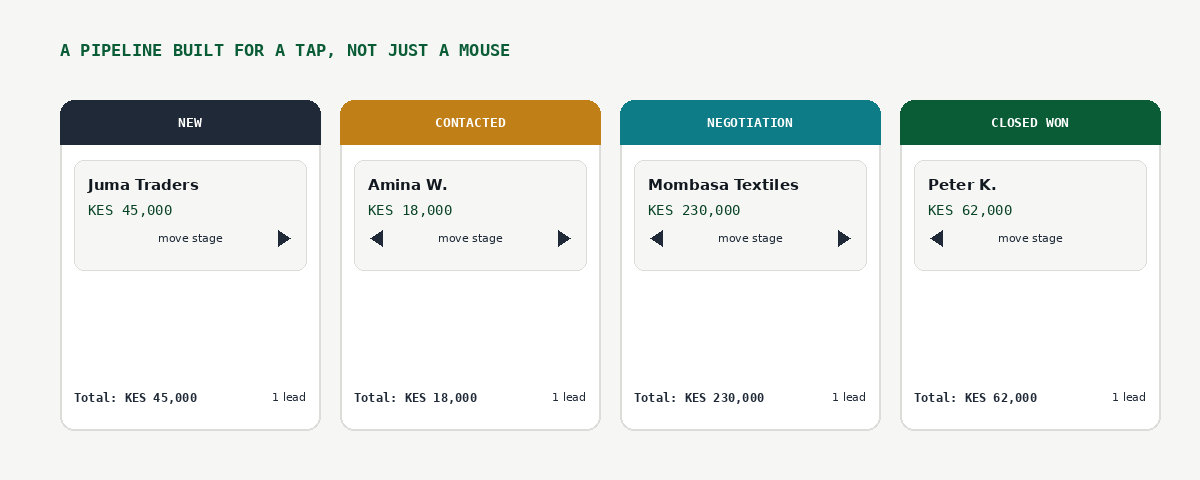
A pipeline that moves a deal forward or back with a tap on a chevron, rather than requiring a precise drag gesture, works equally well on a touchscreen and a desktop. It's a small interaction detail that matters a lot in practice, because the CRM only helps if people actually use it consistently, wherever they happen to be.
3. M-Pesa should be reachable from the lead itself
Generic CRMs treat payment collection as somebody else's problem, usually handled in a completely separate accounting or payments tool. For a Kenyan sales process, where a deal often closes with an immediate M-Pesa payment request, that separation adds a step that doesn't need to exist.
Look for the ability to send an M-Pesa payment request directly from a lead record, and just as importantly, a way to see payments that came in but haven't been matched to any lead yet. Unmatched payments are a real, recurring problem, not an edge case, and a CRM that can't surface them leaves that reconciliation work entirely on you.
4. WhatsApp needs to be built in, not a paid add-on you bolt on later
If your sales conversations already happen over WhatsApp, and for most Kenyan SMEs they do, a CRM that treats WhatsApp as an afterthought (or worse, an expensive third-party integration) is asking you to duplicate effort between two systems. Click-to-chat from a lead record, and visibility into inbound WhatsApp messages that haven't been matched to an existing lead, should be part of the core product.
5. A lost deal shouldn't be a dead end
Most CRMs treat "closed lost" as exactly that, closed, done, filed away. In practice, a lead that went quiet three months ago sometimes comes back. A procurement cycle restarts, a budget gets approved, priorities shift.
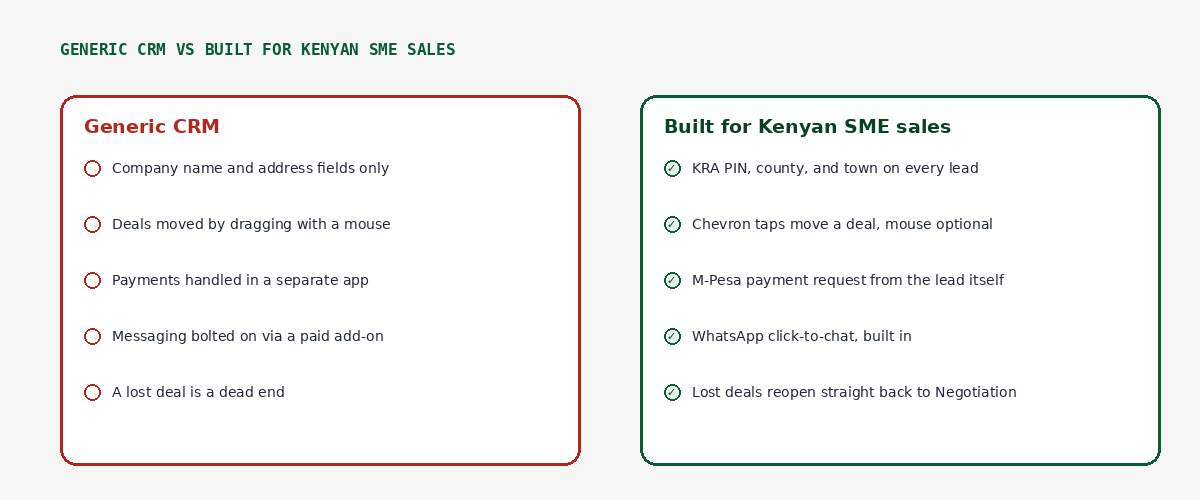
A CRM that lets you explicitly mark a deal lost from any pipeline stage, and just as easily reopen it back into an active stage like Negotiation, treats this as the normal business reality it is, rather than forcing you to recreate a lead from scratch every time a cold deal warms back up.
6. A won deal should connect to what happens next
Closing a deal in the CRM and then manually retyping the same customer, line items, and pricing into a separate invoicing or ERP system is exactly the kind of duplicate work that causes errors and wastes time. Look for a CRM that can hand a won deal directly into a quote in your accounting or ERP system, carrying the details across instead of making someone re-enter them.
What this adds up to
None of these six things show up clearly in a five-minute demo focused on the pipeline view, which is exactly why they're worth asking about directly. A CRM is a sales tool, but if it was built without Kenyan payment methods, messaging habits, and sales patterns in mind, you end up doing the adapting instead of the software. Ask specifically about the points above before you commit, not after.