
Permanent, Contract, Casual, or Intern? What Kenyan HR Software Should Actually Track
Most small businesses in Kenya don't have one kind of worker, they have several. A shop might have two permanent staff, a bookkeeper on a fixed one-year contract, a handful of casual laborers who come in for loading days, and an intern helping out for the semester. Each of those relationships is genuinely different under Kenyan employment law, and treating them all as one undifferentiated "employee" record in your HR system is where a lot of avoidable trouble starts.
Why the distinction isn't just paperwork
It's tempting to think of employment type as a label, something you note down and move on from. In practice it changes real obligations:
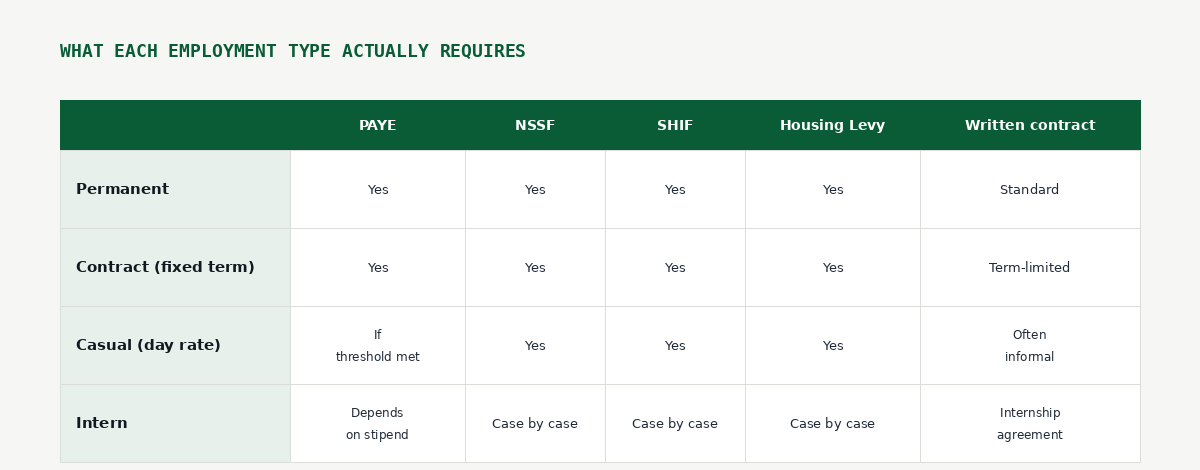
A permanent employee and a casual laborer paid by the day are not interchangeable from a compliance standpoint, even if they're doing similar work on a given day. Getting the classification wrong, or worse, not tracking it consistently at all, tends to surface at the worst possible time: during a labour dispute, an audit, or when a statutory body asks for records you don't have organized.
The employment types, briefly
Permanent employees are the default most HR thinking is built around: an ongoing contract, full statutory deductions, standard leave entitlements, and the fullest set of protections under the Employment Act.
Contract (fixed-term) employees are hired for a defined period or a defined project. They're still owed full statutory deductions and a proper written contract, but the term itself, and what happens at its end, needs to be tracked deliberately rather than left to informal understanding.
Casual laborers are the category that gets the least structured attention and probably needs the most. Paid by the day, often without a formal ongoing relationship, casual work still carries real statutory obligations once certain conditions are met, and Kenyan law has specific provisions about when continuous casual engagement starts to look like something closer to regular employment. This is exactly the kind of nuance that's easy to lose track of with a paper attendance sheet or a WhatsApp message thread as your only record.
Interns sit in their own category, often governed by an internship agreement rather than a standard employment contract, with obligations that depend heavily on whether and how much they're being paid.
Where this actually shows up in day-to-day operations
The clearest example is casual labor. A warehouse or retail operation that brings in day workers for loading, stocktaking, or seasonal peaks needs a simple, honest answer to a question that sounds basic but often isn't: who worked which days, at what rate, and what's owed?
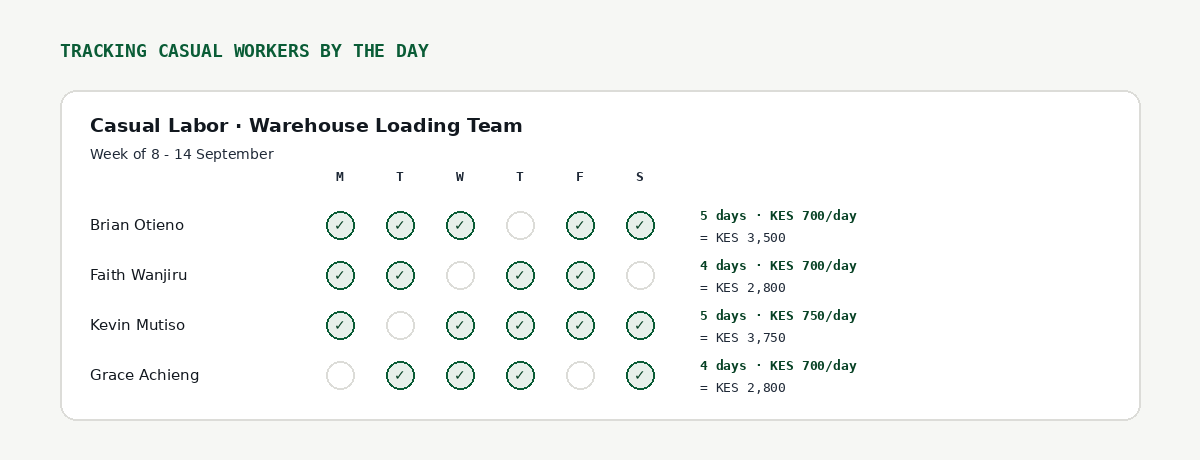
Without a system for this, the usual fallback is a notebook, a spreadsheet someone updates inconsistently, or trusting memory at the end of the week. All three break down as the team grows past a handful of people, and none of them give you a clean record if a worker's hours or pay are ever disputed, or if a labour officer asks for documentation.
What this means for choosing HR software
A lot of HR software, especially anything built for a market where "employee" mostly means one thing, doesn't have a real answer for casual labor at all. It might let you add a note in a free-text field, but it won't actually track daily attendance, calculate day-rate pay accurately, or keep casual workers cleanly separated from permanent staff in reporting.
The practical checklist, if you're evaluating a system:
- Can you record employment type per person, not just as a label but as something that changes what fields and calculations apply?
- Is there an actual daily attendance and pay mechanism for casual workers, not just a generic "employee" record repurposed?
- Does the system keep next of kin, emergency contact, and statutory numbers (KRA PIN, NSSF, SHIF) on file for every category, not just permanent staff?
- Can you generate a clean record of who worked when, if you're ever asked to produce one?
- Does whatever handles payroll actually read this employment type correctly, rather than assuming everyone gets the same statutory treatment?
None of this is exotic. It's just the difference between HR software that was designed with the Kenyan labor market's actual shape in mind, several employment types, not one, and software that was designed elsewhere and had "casual employee" bolted on as an afterthought, if it exists at all.